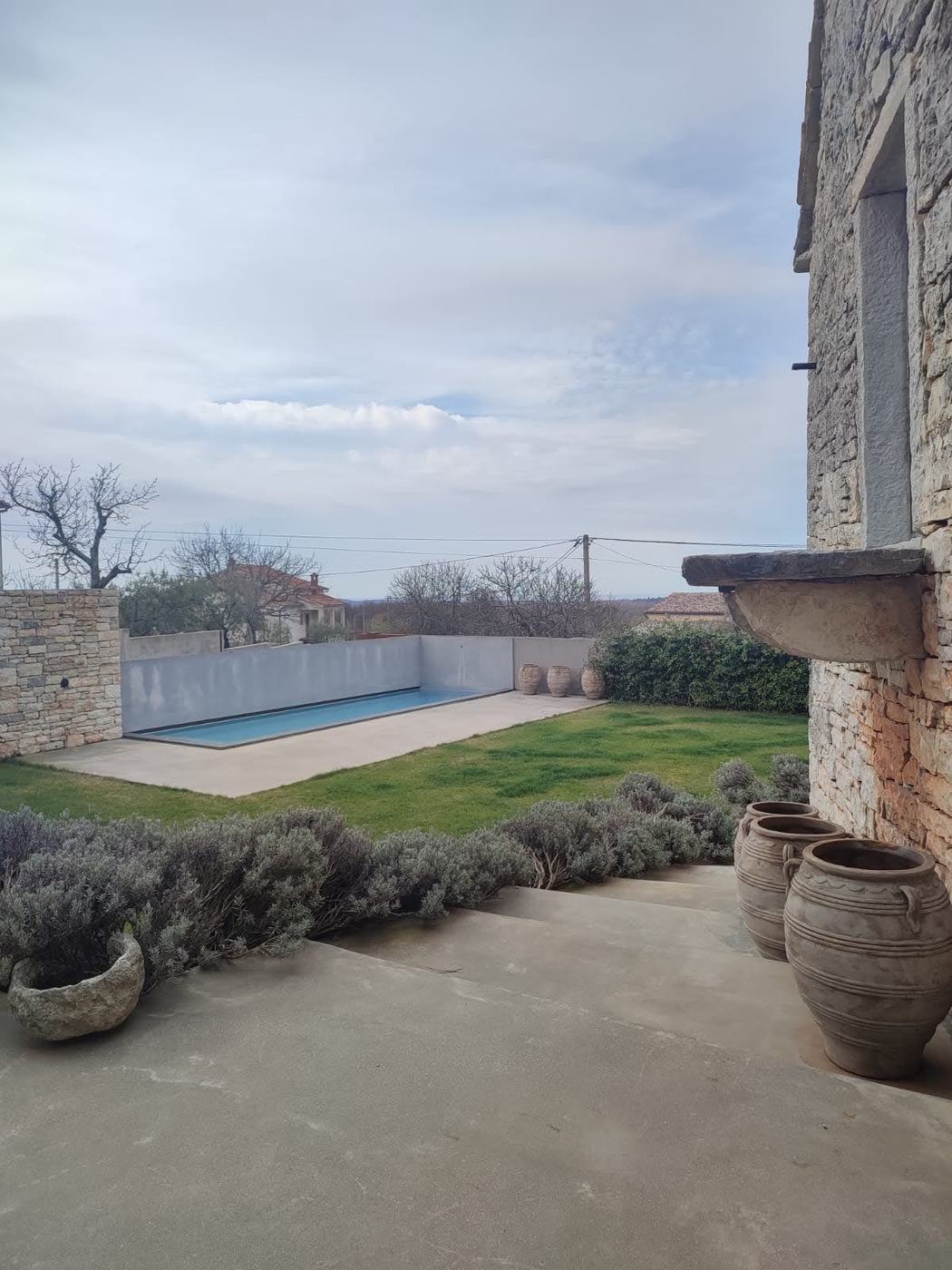
Owners who close up their holiday house on the Croatian coast in October and come back in May often find an unpleasant surprise: moss in the lawn, oleanders reduced to bare sticks, a drip irrigation system running at half capacity, wind damage nobody reported. All of it develops in the months when the garden appears to be dormant and is in fact changing considerably.
The Mediterranean garden does not really rest in winter. It simply works more quietly. The decisions that determine how it looks and how healthy it is in high season are taken between November and May, not in July.
Why winter in Dalmatia works differently
Dormancy is short and incomplete. Mediterranean woody plants (olives, citrus, bay, rosemary) keep their leaves and only reduce their metabolism. They go on transpiring and need attention during long dry spells.
The bura is the main winter risk. This cold north-easterly reaches hurricane force at exposed coastal sites, breaks branches, topples container plants and carries salt. The characteristic brown, scorched leaf margins after a stormy January are not frost damage but salt damage.
Frost is unreliable. On the coast temperatures usually stay above zero, but inland valleys see regular nights at −5 °C. Citrus, bougainvillea and irrigation systems are genuinely at risk there.
Winter is the only rainy season. November to March brings most of the annual rainfall. It fills the soil’s water store, and it also causes erosion, waterlogging and nutrient leaching.
Summer drought has to be prepared for. Without irrigation and mulch established in spring, the garden is brown by July, and there is no second attempt.
Versailles and Dalmatia: two ideas of a garden
The garden as a demonstration of power
André Le Nôtre’s Versailles of the 17th century embodied human command over nature. Everything aligned to a central axis, hedges formed straight walls, trees stood in rigid grids. Water, scarce on the site, required elaborate aqueducts and pumps, including the purpose-built Machine de Marly. Water as spectacle, not as a resource to be managed.
The garden as a survival strategy
The Dalmatian garden grew out of the opposite conditions: thin karst soil, seven to eight months without rain, salt air and a wind that levels things. That produced a coherent system:
- Dry-stone walls instead of axes. Terraces hold the soil and store heat.
- Cisterns instead of aqueducts. Roofs catch the rain; tanks keep it.
- Pergolas instead of sight lines. Shade matters more than a view.
- Use and ornament in one. Olives, figs and vines are yield, structure and beauty at once.
- Enclosure instead of expanse. Walled inner gardens give protection.
Notably, even the grand summer residences of Ragusa put terraces, pergolas and cisterns first, for all their Renaissance aesthetics.
The real difference: how they are maintained
Versailles needs constant labour against natural forces; stop, and it deteriorates. The Mediterranean garden demands the opposite: few interventions, carried out at exactly the right time. An olive tree neglected for three years has not simply become “a bit overgrown”. It has rebuilt the architecture of its crown, and putting that right takes years.
The distinction: Versailles demands diligence, Dalmatia demands timing.
Winter work: November to February
Pruning, the core winter job
Olives are traditionally pruned between late February and early April, after the risk of frost but before growth starts. The aim is an open vase that lets light and air through. Remove vertical water shoots, root suckers, crossing and inward-growing branches and dead wood. A well-pruned tree fruits more heavily, dries faster after rain and stands up to wind better.
Vines are cut during dormancy, usually January or February, so that the cuts do not bleed excessively.
Figs tolerate thinning at the end of winter but need restraint. Part of the crop ripens on the previous year’s growth.
Pomegranate gets thinned in winter, with root suckers removed thoroughly.
Cypresses need particular care. Cypress canker is widespread along the Adriatic. Infected branches (recognisable by resinous cracks in the bark and dying twigs) have to be cut back into healthy wood and disposed of. Never cut cypresses in wet weather, and disinfect tools between trees so the disease is not carried on.
Frost protection for sensitive plants
Citrus (lemon, orange, mandarin) needs watching. When frost below −2 °C is forecast, fleece over the crown, a mulch layer over the roots and a position against a south-facing wall all help. The soil in a container freezes faster than the parts above ground, so raise pots and insulate the containers.
Harvesting continues through the winter; pruning waits until after the harvest in spring.
Bougainvillea, hibiscus and frangipani need protection or a frost-free winter position in exposed places. Bougainvillea often freezes back above ground but regenerates from the rootstock if the roots were mulched.
Winterising the irrigation
Frequently underestimated, and it prevents expensive damage:
- Shut off the main supply and drain the system completely
- Empty or remove filters, pressure reducers, solenoid valves and water meters
- Blow out above-ground drip line and spray nozzles
- Drain rainwater tanks and cistern pumps
- Shut off outdoor taps and leave them open
A ring main that splits under a terrace costs thousands and often goes unnoticed until May, by which time water has been running for weeks.
Storm preparation and the inspection after a bura
Before winter, store parasols, shade sails, light furniture, cushions and anything decorative. Group large containers where they are sheltered, or weight them.
After a significant bura, check for hanging or torn branches, displaced roof tiles, toppled pots, blocked drains and damaged fencing. Close to the water: rinse plants with fresh water to wash salt deposits off the foliage.
Soil and mulch
Winter rain is the opportunity to feed the soil. Work compost or well-rotted manure in around fruit trees and add a mulch layer of bark, wood chip or residues from olive processing. That protects slopes from erosion, suppresses weeds and, decisively, holds moisture through the summer.
After heavy rain, check terrace edges and dry-stone walls for erosion damage. Repairs in winter are still cheap.
Watching for pests in winter
Winter shows up problems early, while they are still manageable.
Pine processionary moth: the white silk nests in pines are visible in winter. The caterpillars march to the ground between February and April; their hairs cause severe skin reactions in people and can be fatal for dogs. Nests must be removed by professionals with protective equipment, never yourself, and never with a jet of water.
Scale and mealybug on citrus and bay respond well to oil treatments in winter.
Red palm weevil: Canary date palms need checking regularly for drooping central fronds, bore holes and feeding damage. Cut wounds on a palm attract the beetle. Avoid pruning during the main flight period. Many municipalities require infestations to be reported.
Lawn and hard surfaces
Lawns rest. Bermuda grass, the standard on the Adriatic, goes completely brown in winter. That is normal, not damage. Do not fertilise, scarify or walk on it heavily.
Stone terraces, steps and paths grow algae and moss in the damp winter and become genuinely slippery. Cleaning them at the end of winter keeps them looking right for the whole season. Timber decks must be completely dry before they are treated.
Spring work: March to May
Everything here depends on getting the timing right.
Pruning flowering shrubs, where timing is critical
The most common mistake in a Mediterranean garden is cutting in the wrong season. The rule: plants that flower on this year’s growth are pruned in spring before growth starts; plants that flower on last year’s wood are pruned after flowering.
Oleander flowers on new growth. Prune in late winter or early spring. Rejuvenate by taking the oldest stems out at ground level. Always wear gloves; every part of the plant is highly toxic.
Bougainvillea flowers on new wood; prune in spring, keeping the framework branches.
Lavender gets a light shaping in spring; the main cut follows after flowering in summer. Never cut into bare, unleafed wood. Lavender does not regenerate from lignified growth.
Rosemary, sage and santolina get a moderate shaping after flowering, never into the woody interior.
Hibiscus tolerates a hard spring prune.
Feeding
Growth in March and April creates the peak demand for nutrients.
Olives get a nitrogen-rich feed before flowering, ideally before rain or after watering.
Citrus needs a specialist feed containing iron and magnesium. Yellow leaves with green veins are typically iron deficiency, caused by the region’s limy soils.
Lawns are fed only once the Bermuda grass genuinely greens up, usually April.
Container plants get fresh soil in the top layer, or repotting.
Bringing the irrigation back into service
A critical spring job, and more than opening the main valve:
- Fill the system slowly, building pressure gradually
- Run each zone individually and watch the coverage
- Clean filters, check drippers for blockages, because the hard, chalky Adriatic water clogs them reliably
- Repair leaks, frost cracks and rodent damage on above-ground lines
- Reposition spray heads, which shift over winter
- Update the controller programme, replace timer batteries, test rain sensors
- Adjust the watering schedule for the season: early morning, infrequent but thorough
A system running at seventy per cent goes unnoticed in April. August shows you exactly which drippers failed.
Weeds, new planting and the lawn
Winter rain produces explosive weed growth. Weeding thoroughly in spring and then mulching saves a battle that otherwise runs all summer.
New planting belongs in early spring, or better still, in autumn. Young trees need reliable summer irrigation to survive their first drought.
Scarify the lawn as growth begins, overseed and roll. Bare winter patches close quickly if they are overseeded before the season starts.
Getting ready for the season
By April the focus shifts to how the place will be experienced: edge the borders, shape hedges, clean the paths, test the garden lighting and replace bulbs, bring the furniture out of store, clean and oil the timber pieces, check the pool and shower areas.
Fire safety deserves to be taken seriously. Remove dried prunings, dead grass and brush before summer starts. Most counties enforce strict burning bans during the summer months; restrictions apply outside those periods too, often requiring notification to the municipality. Non-compliance carries substantial penalties, and the risk is real.
Six mistakes that recur
-
Pruning too late. Cutting olives in May costs the harvest and weakens the tree.
-
Leaving the irrigation check until June. Repairs become impossible to schedule and the plants are already stressed.
-
Cutting lavender and rosemary into old wood. They do not regenerate and have to be replaced.
-
Skipping the mulch layer. Summer water consumption multiplies without it.
-
No winter inspections at all. Burst pipes, caterpillar nests and weevil infestations stay undetected for months, and the cost escalates.
-
Planting against the site. Ornamental turf, box and bedding plants are a permanent subscription to water bills and pest control. Mediterranean planting halves the care required.
The distance problem
All the work described shares one characteristic: its timing follows the weather, not your holiday calendar. Olives are pruned after the last frost. The bura inspection follows the storm. The irrigation has to run before the drought arrives.
For owners who come two or three times a year, coordinating that remotely is close to impossible. This is exactly what looking after a property locally covers: watching over it in winter, pruning properly at the right time, maintaining the irrigation, keeping an eye on pests and preparing the whole place for the season, documented so that the owner can see what was done.
The difference shows up not in winter but in July, when you or your guests arrive.