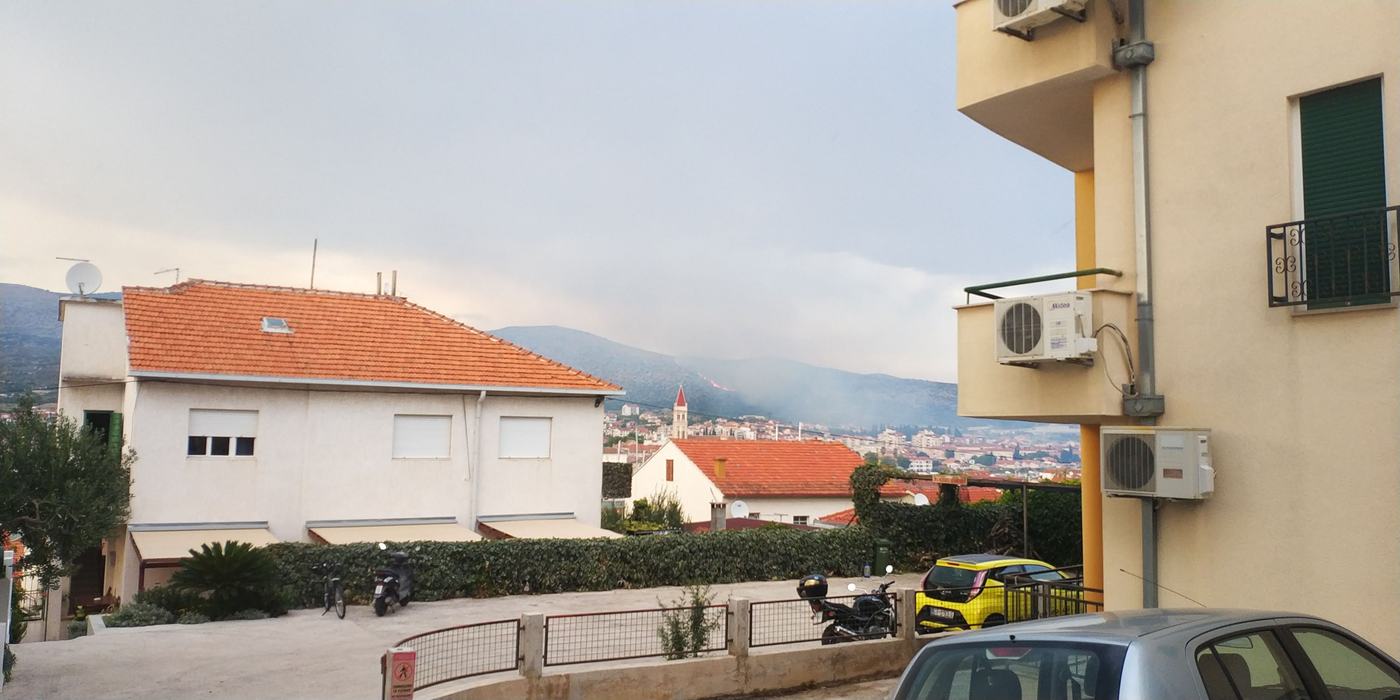
On the evening of 13 August a fire broke out in woodland by the road at Lokva Rogoznica. Driven by strong wind, it reached Omiš the same night. By the following morning it had spread across a strip roughly 23 kilometres long and about 1.5 kilometres wide, burning around 1,000 hectares of grass, maquis and pine forest.
One person died. Nearly 40 people were injured, several of them seriously. Around 2,500 residents and holidaymakers had to be evacuated, some of them by sea because the Adriatic coast road was closed.
According to figures published by the prefect of Split-Dalmatia County, completely destroyed were: 28 houses, 106 vehicles, 45 boats that had been pulled ashore, seven commercial premises, three restaurants and six outbuildings. A further 43 houses, 20 vehicles and nine boats were partly damaged. Damage to agricultural land, including olive groves, has not yet been quantified.
We are writing this because Omiš and the places along the coast up to Lokva Rogoznica are part of our area, and because many owners who are not there right now have the same two questions: is my house affected, and what do I have to do?
What those affected should do now
The order matters, and some deadlines are short.
1. Have the condition recorded before anything is cleared up.
Damage must be documented before you or anyone else starts clearing. Photographs from every side, overviews and close-ups, with date and time visible, including soot, heat damage to windows, shutters, plastic parts, air conditioning and pipework. Smoke damage indoors is regularly underestimated and hard to prove later.
2. Inform your insurer without delay.
Most Croatian buildings policies cover fire as a basic risk. Report the damage in writing and as early as possible, even if the extent is still unclear. Ask explicitly about: smoke and soot damage, clearing and disposal costs, damage to outdoor areas, and (if you rent it out) loss of rental income. Boats go through hull insurance, vehicles through comprehensive cover.
3. Mind the deadline for reporting to the town.
The prefect has announced that once the surveys are complete he will apply for a natural disaster (prirodna nepogoda) to be declared. If it is declared, the applicable law sets a reporting deadline of eight days from the day of the decision, extended to twelve in justified exceptional cases. Reports are made on the official form PN to the town of Omiš or the responsible municipality.
Two points are often missed: the deadline runs from the decision, not from the day of the fire, so watch the town’s announcements. And state assistance under this law is aimed at uninsured assets; anyone who is insured is referred to their policy. Report the damage anyway if in doubt, since the record also forms the basis for the overall assessment.
4. Do not sign anything you have not read.
After large-scale damage, firms go around offering immediate restoration. Reputable businesses have no problem giving you a written quote and waiting for the insurer’s approval.
5. Safety before speed.
Burnt areas are not safe once the flames are out: embers under roots and stones, unstable trees, damaged power lines, loose rocks on slopes whose protective netting has burned away. Do not enter your property before the emergency services release it.
Why it moved so fast, and what follows from that
A fire of this kind does not move as a front, it jumps. The wind carries sparks and burning needles hundreds of metres ahead, and these spot fires ignite the next dry thing they hit. That is why cars burned on the coast road and boats standing ashore burned, while houses next to them were left standing.
For preparing a property that means: what decides the outcome is not the distance to the forest but what lies in the first thirty metres around the house, and whether embers can get inside the building.
-
Growth against the house: keep dry grass short, remove brushwood and cuttings, cut back or remove pines and cypresses directly against the façade. Oleander, rosemary and bay burn hot once they have dried out.
-
Roof and gutters: clear needles and leaves from gutters and from the angles of the roof. That is where spot fires take hold.
-
Openings: shutter boxes, ventilation grilles, chimney openings and roof overhangs are the typical entry points. Metal insect screens hold sparks back, plastic ones do not.
-
Anything movable: never store gas bottles, jerry cans, firewood or garden furniture against the house wall. Firewood stacks belong at least ten metres away.
-
Vehicles and boats: a boat on a trailer beside the house is an accelerant with a plastic hull and a fuel tank.
-
Water: a working outdoor tap with a long enough hose helps the firefighters defending your house. A cistern or pool is a resource, if somebody knows it is there and where the access is.
-
Access: can a fire engine reach the house and turn around? Overhanging branches and a blocked turning area can decide whether anyone comes at all.
It is also worth a sober look at the policy: is the sum insured still current, or does it date from the purchase price ten years ago? Are outbuildings, the pool, outdoor areas and contents included? Are there clauses about extended vacancy? Underinsurance is only ever noticed when a claim is made.
The point you cannot solve from a distance
On the night of 14 August the decisive question for many owners was not whether they were well insured. It was: is my house still there, and does anybody on the ground know?
If you are not in Croatia, there is nothing you can do on a night like that. But a great deal is decided in the days afterwards: whether the damage is fully documented, whether the report reaches the town in time, whether the insurer is informed promptly, whether somebody secures a property that has been broken open or left unsecured. And more is decided before that, whether the grass was cut in June, whether the gutter was clear, whether the gas bottle was not standing against the house wall.
That is not a question of equipment. It is a question of presence.
We can help
If your property lies between Lokva Rogoznica and Omiš and you are not there: we will drive out, document the condition with photographs, come back to you the same day and support you with the insurance report and the damage notification to the town. For those directly affected, the first assessment is free of charge.